

Mexico
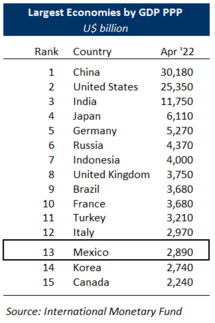 Mexico is the 13th largest economy in the world. With a median age of just 29 years, its fairly young approx. 130 million population, generates a GDP PPP of U$ 2,700 billion.
Since the end of the 1980’s, the country’s economy has been rapidly liberalized, positioning it for continued growth.
During the last 35 years, Mexico has evolved with internal changes that include the privatization of key sectors and industries and an overall significant reduction in role of government in business, as well as external changes that include the renegotiation of USMCA and the signature of free trade agreements with over 45 nations, major import-duty reductions, and the promotion of Foreign Direct Investment (FDI).
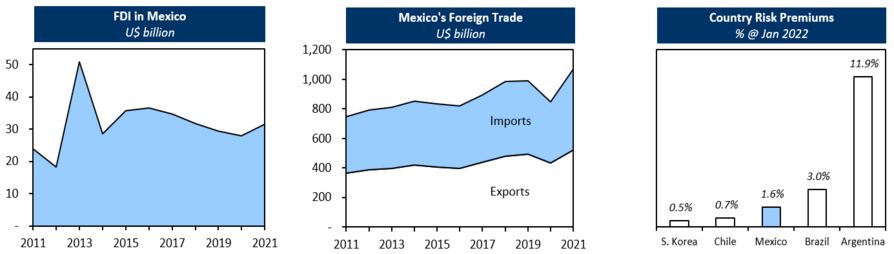
The international investment community has now clearly recognized the country’s economic and political achievements, resulting in Investment Grade ratings since 1999. As a result, Mexico has risen into a distinct category, above many of its Latin American competitors.
The following graphs show Mexico’s FDI and International Trade behaviors in recent years, as well as the Risk Premium in January 2022:
Since 2018, with the presidential election of a center-left leader, the attention of the institutions has shifted towards a large segment of the population that had been lagging behind for decades, adjusting paradigms in the country's socioeconomic structure with the objective of closing social gaps.
Following the presidential elections in the year 2000, a healthy political alternance was initiated after 7 decades of a single-party rule. Such balance was the logical result of economic liberalization and greater accountability demanded by society.
Since 2020, the significant negative effects on economic systems caused by the Covid-19 pandemic have resulted in strong disruptions to global production and logistics models. As a result, the US market has understood the need for near-shoring, giving rise to a strong and sustained investment in manufacturing plants and distribution centers in Mexico, which will decisively support economic development during the next decade.
Nonetheless, investors should be aware of the many challenges that lie ahead, most notably in the areas of social development, including education, health, employment, justice, and growing insecurity. These are significant and will take decades to resolve. Hurdles in the business sector include breakup of private / public oligopolies and fostering a culture of respect for consumers and society. As has been seen in many countries throughout history, long term economic stability cannot be attained without social justice.